

Is EPDM rubber strip resistant to oil?
As a supplier of EPDM rubber strips, I often encounter inquiries from customers about the properties of our products, especially their resistance to oil. This is a crucial question, as the performance of rubber strips in oil - containing environments can significantly impact their application in various industries. In this blog, I will delve into the topic of whether EPDM rubber strips are resistant to oil, exploring the scientific basis, real - world applications, and limitations.
Understanding EPDM Rubber
EPDM, or ethylene propylene diene monomer, is a synthetic rubber known for its excellent weather resistance, ozone resistance, and electrical insulation properties. It is composed of ethylene, propylene, and a small amount of diene monomers. The unique molecular structure of EPDM gives it a high degree of saturation, which contributes to its good resistance to environmental factors.
Oil Resistance of EPDM Rubber Strips
The oil resistance of EPDM rubber strips is a complex topic. Generally speaking, EPDM rubber has relatively poor resistance to mineral oils, such as those commonly found in automotive engines and industrial machinery. Mineral oils contain a variety of hydrocarbons, and the non - polar nature of these hydrocarbons can cause EPDM rubber to swell and lose its physical properties over time.
When EPDM rubber strips come into contact with mineral oils, the oil molecules can penetrate the rubber matrix. This penetration disrupts the intermolecular forces within the rubber, leading to an increase in volume (swelling) and a decrease in hardness. As a result, the rubber strip may lose its sealing ability, mechanical strength, and dimensional stability.
However, EPDM rubber shows better resistance to certain types of synthetic oils. Synthetic oils are engineered to have specific chemical properties, and some of them have a lower affinity for EPDM rubber. For example, silicone - based synthetic oils and some phosphate - ester - based synthetic oils have less of an impact on EPDM rubber compared to mineral oils.
Real - World Applications and Considerations
In automotive applications, Car Window Rubber Strip and Car Windshield Rubber Strip are often made of EPDM rubber. These rubber strips are mainly exposed to the external environment and are not typically in direct contact with oil. Their primary functions are to provide a seal against water, dust, and noise. In this context, the excellent weather resistance of EPDM is more important than oil resistance.
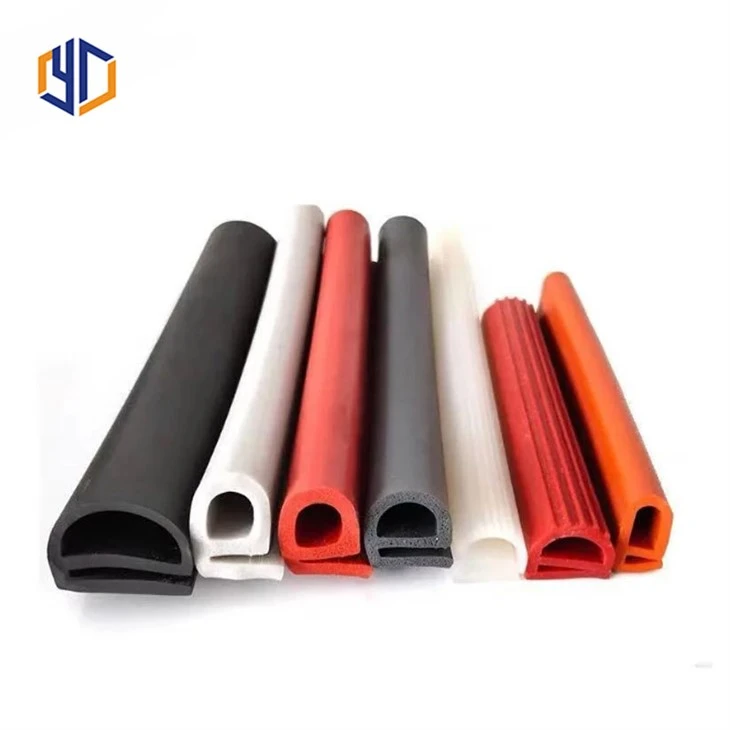

On the other hand, rubber strip for door gap may have a small chance of coming into contact with oil if there is an oil leak in the vehicle. In such cases, the limited oil resistance of EPDM may be a concern. If the rubber strip is expected to be exposed to oil for an extended period, alternative rubber materials with better oil resistance, such as nitrile rubber (NBR), may be more suitable.
In industrial applications, EPDM rubber strips are widely used in applications where oil contact is minimal. For example, in the electrical industry, EPDM rubber is used for cable insulation and sealing due to its good electrical insulation and weather resistance. In the construction industry, EPDM rubber strips are used for window and door seals, where the main requirements are weatherproofing and airtightness.
Improving Oil Resistance of EPDM Rubber Strips
Although EPDM rubber has inherent limitations in terms of oil resistance, there are several ways to improve its performance in oil - containing environments. One approach is to use additives. Certain additives can be incorporated into the EPDM rubber formulation to enhance its resistance to oil. For example, anti - swelling agents can be added to reduce the amount of oil absorption and swelling.
Another method is to modify the rubber surface. Surface treatments, such as coating the EPDM rubber strip with a thin layer of oil - resistant material, can provide a barrier between the rubber and the oil. This can effectively prevent the oil from directly contacting the rubber matrix and reduce the impact of oil on the rubber's properties.
Conclusion
In conclusion, EPDM rubber strips have limited resistance to oil, especially mineral oils. However, their excellent weather resistance, ozone resistance, and electrical insulation properties make them suitable for a wide range of applications where oil contact is minimal. In applications where oil resistance is a critical requirement, alternative rubber materials or methods to improve the oil resistance of EPDM should be considered.
If you are looking for high - quality EPDM rubber strips for your specific application, our company can provide you with a variety of options. We have a team of experts who can help you select the most suitable rubber strip based on your requirements, including factors such as oil resistance, temperature range, and mechanical properties. Whether you need rubber strips for automotive, industrial, or construction applications, we are here to assist you. Feel free to contact us to discuss your procurement needs and start a business negotiation.
References
- Morton, M. (1995). Rubber Technology. Van Nostrand Reinhold.
- Rodgers, W. (2004). Synthetic Elastomers: A Comprehensive Review. Rapra Technology.